Are we on the brink of a new space race to the Moon? Nisha Beerjeraz-
Hoyle explores how returning to the Moon could pave the way for the human exploration of Mars. Published July 2019.
Mention the future of human space exploration and I can guarantee you that the Moon will crop up in conversation, with the two being spoken about in tandem. It also seems to be dominating space agencies’ mission plans, fuelling speculation that we are on the brink of a second space race to return to our companion satellite. The prospect has received mixed-reactions, with some cautious about the consequences of colonising another world.
NASA promptly turned their focus back to lunar development following the US Space Policy Directive-1 (2017), which set out that: “the United States will lead the return of humans to the Moon for long-term exploration and utilisation, followed by human missions to Mars and other destinations..”
They were not alone in doing so; other agencies including ESA, JAXA and Roscosmos have all had lunar initiatives running alongside other exploratory missions. The Global Exploration Roadmap, produced by a forum of of 15 space agencies (known as the International Space Exploration Coordination Group (ISECG)) illustrates the emerging consensus and partnership towards furthering human presence in the Solar System – with the Moon being the next logical step.
The usual concerns still crop up – a primary one being the expense of a renewed lunar programme. NASA alone will be spending 51% of its total proposed 2020 budget on lunar development, despite the overall pot of money being smaller by 2.2% compared to 2019. Activities such as Earth Sciences and STEM will take a hit.
It is unclear how much other agencies are committing or what missions will be sacrificed as a result. Although a scaled-up year-on-year budget should provide reassurances, there are still concerns that costs will balloon, jeopardising timelines and therefore other deep space missions. Collaboration with private organisations should mean a leaner commercial model, although we know from past problems that stellar-performing programme managers will be vital to keep everything on track.
With so much sacrifice and risk, is it worth it? Well, although the Apollo missions broadened our understanding of the Moon, we have really only explored a tiny fraction of it – there’s more to discover.
Earlier this year, China’s Chang’e-4 landed on the far side of the Moon for the very first time in space history, in an unexplored region of the South Pole-Aitken basin. As the largest and oldest basin on the Moon, its thinner crust has left the lunar mantle exposed at the surface. We may be able to access to pristine samples dating back to the early Solar System, which could reveal the origins of the Earth-Moon system, as well as the formation of Earth.
Given that we have well-developed robotics out in space already, some may argue that lunar science alone cannot be reason enough to build a human outpost. In an A&G article “Why we should build a Moon village”, Dr Ian Crawford, a Senior Research Associate at the Birbeck College, University of London and past SPA President, explains that many scientific fields ranging from planetary science, astronomy, astrobiology, life sciences and fundamental physics might benefit. He says, “Having humans living and working on the lunar surface for long periods is likely to result in unanticipated discoveries that might not otherwise be made.”
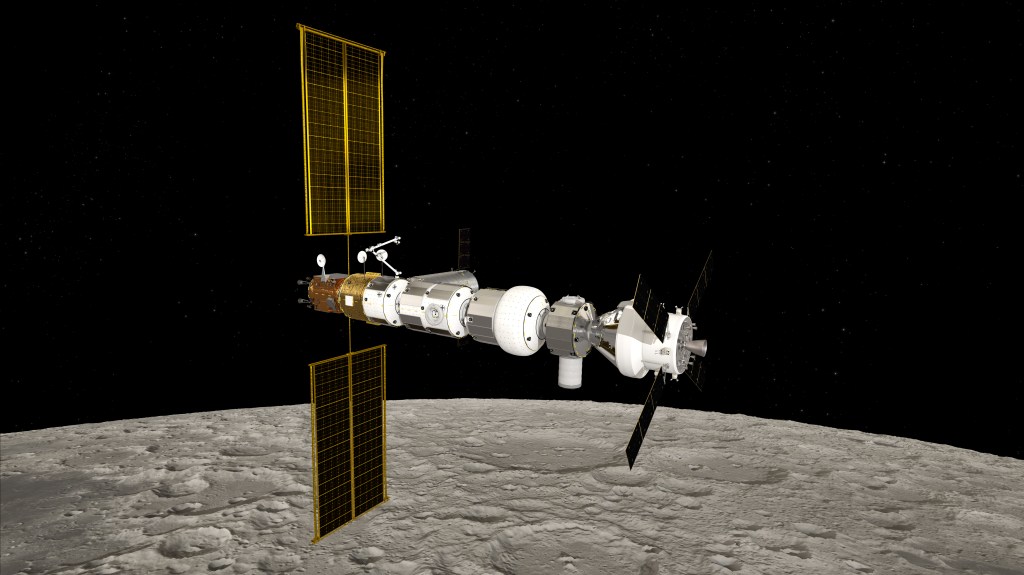
The wheels are already in motion to get us there. In April 2019, NASA released ambitious timelines to land astronauts on the Moon by 2024. Partnering with organisations and international agencies, they are simultaneously developing the Orion spacecraft and Space Launch System (SLS) to be launch-ready by 2020, a Lunar Gateway (Gateway) and reusable lander by 2022 and 2023, and finally a crewed mission in 2024. The emphasis on sustainable architecture permeates everything too.
Part of the urgency lies in the intense interest from all agencies in establishing access to the Moon’s resources. On the surface, the Moon looks like a barren wasteland; look beyond and it is rich in resources such as water ice. Polar water-ice deposits could be extracted and processed to produce propellant in situ – known as In Situ Resource Utilisation (ISRU). Spacecraft could use the Gateway or Moon Village as refuelling ports and a launch pad – a much cheaper alternative than hauling it from Earth. ESA is currently researching the feasibility of conducting Moon ISRU by 2025, starting with a prospecting exercise in partnership with Russia’s Luna-27 mission in 2022 to detect and characterise polar volatiles.
Fuel resource is just the tip of the iceberg. A permanent base needs life support and power systems, water supplies, consumables and materials. This expands it from being merely a petrol station to a scalable lunar industry, with many opportunities for commercialisation and tourism, as well as a new scientific laboratory from which we can study space.
No one wants to be left out and this need to have a stake in colonisation, some ownership of the process, may be the biggest challenge we must overcome to avoid destroying all the progress made.
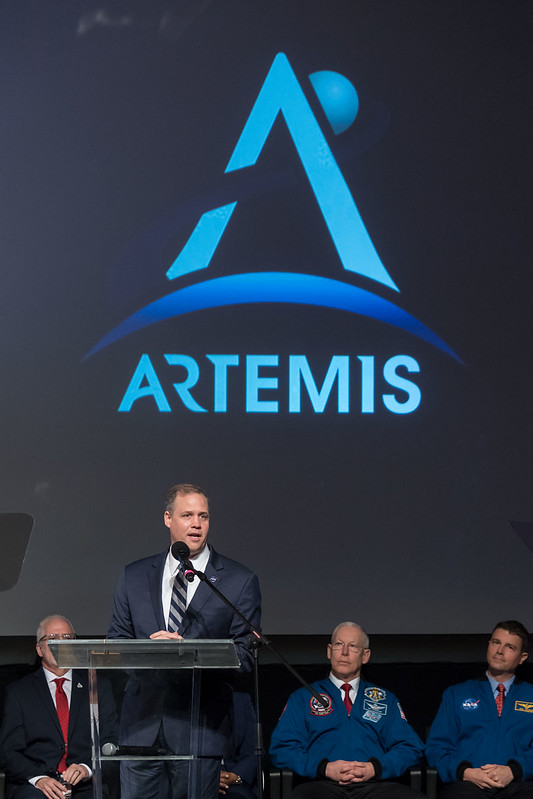
In a press release NASA Administrator, Jim Bridenstine said, “This time, when we go to the Moon, we will stay. We will use what we learn as we move forward to the Moon to take the next giant leap – sending astronauts to Mars.” Yet some critics think that the Moon is an unwelcome distraction that could upend the plans for Mars, despite plans for Mars sample missions to run in parallel to a lunar programme.
Mars is still the horizon goal and NASA remains optimistic on reaching Mars in the 2030s. In a 2014 report by the US National Research Council called Pathways to Exploration, an independent committee concluded that “a return to extended surface operations on the Moon would make substantial contributions to a strategy ultimately aimed at landing people on Mars.”
Simply put, it’s not in our own interests to head straight to Mars. It is still unknown territory despite the information collected by orbiters and rovers from afar. The Moon is a safer environment to test technology, equipment and the psychological impact of leaving our mother planet and living on another celestial body. If something were to go wrong, the Moon is just a three-day journey; people can be brought back or supplies can be ferried relatively quickly.
However, some will argue that the dissimilarities between the Moon and Mars makes it a limited safety-net for realistically testing living conditions. Surely Earth’s more comparable environment and climate offers a shade more realism? One problem with this is that it greatly underestimates the psychological aspects.
From Mars, the Earth and Moon look like bright evening or morning stars to the naked eye. Astronauts will have to mentally acclimatise to feelings of isolation, far from everything and everyone. One of the most memorable quotes from the Apollo 11 mission is that of Michael Collins waiting in the Lunar Command Module for his colleagues to return: “I am alone now, truly alone, and absolutely isolated from any known life.” We need to begin that adaptation – and only truly will when placed into a real environment.
A new venture to the Moon could be exactly the thing to spark inspiration in the next generation – our scientists and engineers of the future – and to act as a catalyst for emerging technology that not only benefits space exploration but also the Earth.
Certainly in an age of widely accessible information failures will face far more public scrutiny. Yet, Israel’s agency, SpaceIL’s recent attempt to land a probe on the Moon demonstrates that even in the event of failure, people focused on the positives, for reaching the Moon still has a certain magic.
There may be setbacks – the sheer amount of work to be done requires deep breaths and steady nerves – but the thought of witnessing the first Gateway or the first touchdown on the Moon in over 50 years fills me with excitement and wonder.
This feature article was published in Popular Astronomy, July 2019 issue.

 Nisha Beerjeraz-Hoyle