Sputnik: 60 years on

Published October 2017

On the night of 4th October 1957, radios around the world broadcast a ‘beep, beep, beep’ and the following morning people woke up to a ‘second moon’ orbiting the Earth.

This month hails 60 years since Sputnik 1 became the first object to reach space and to orbit the Earth, sparking a decade-long Space Race between Soviet Russia and the USA. Although the Apollo 11 Moon-landing in 1969 remains a definitive moment in the Space Race, the journey to that point really started with the quest to launch a satellite.

Sputnik was the advent and the catalyst for this race. Its story is one full of impatient politicians, ambitious scientists, setbacks, tantrums and worldwide fanaticism.

At its forefront, a man. The chief designer of the Soviet space programme: Sergei Korolev. He would go on to launch the first dog, first man and first woman into space. A man whose untimely death in 1967 may have cost the Soviets the race to the Moon.

You do not have to like the Soviet Russians to admire the ingenuity of Korolev, much in the same way that you credit the German’s for their V2 rocket technology, knowing that its first use was to bomb London in 1944 during WW2. Out of the darkest moments for man, arose some of the brightest for humanity.

We start our story in the early 1950s; the US and Soviets were competing to be the first to arm themselves with intercontinental ballistic missiles that could fire nuclear weapons across the oceans. Sending a satellite into space was initially nothing more than a show of power.

In 1953, when the US announced that they would launch a satellite in 1957, the Soviets responded in kind. And to be honest, no one cared save for the scientists working on it. For the public, reaching space was still in the realm of science fiction and fanciful dreams. For the politicians, reaching space was only worthy if done in the pursuit of nuclear missiles.

Korolev’s plans for Sputnik were given approval in 1956, although it was overshadowed by the R7 rocket development (this would lead onto the birth of the Soyuz rocket). In “On the Operations to create an artificial Earth satellite”, it is referred to simply as Object D.

While the US experienced set backs to build a rocket powerful enough to launch a satellite, the Soviets had their own issues.

Object D was simply too heavy, reported the engineers working at a remote factory away from Korolev’s main site. Some serious thrust power would be required to carry Object D. They would need more time.

But time was not something they had. Korolev’s constant paranoia that the US would launch a satellite any day now stressed him immensely. He ordered Object D be brought to him at TyuraTam – the R7’s development site and launch complex – so that he could personally work on it.

The original design for Object D was in fact what we now know as Sputnik 3 (it looks a bit like a Dalek). On board, it was equipped with instruments to make observations of Earth’s atmosphere and magnetic field.

This was all stripped away, leaving only the basics: a reflective, shiny aluminium sphere, no larger than a beach ball, with two simple transmitters, batteries, a thermo-regulator and two pairs of antennae. All it had to do was send a signal to Earth so that people on the ground knew that it was coming from the little sphere hanging above their heads. Sputnik Proteishy was born.

The original launch date of May 1957 and a string of failed test launches of the R7 through the summer months (5 in total) almost cost Korolev the programme. Given one final chance, Korolev and his team managed a successful launch of the R7 in August 1957. Next up: the launch of Sputnik.

On 4th October at 22.28, Sputnik transmitted its famous beep signal to the world.

Russia continued to sleep. The then Premier, Nikita Khrushchev, on being awoken by a phone call, told Korolev to go back to bed. Yet the rest of the world stood to attention. That very evening, US politicians and Wernher Von Braun – the German scientist who had been working for the US space programme to launch their own satellite – were sipping cocktails at a party when they got the phone call informing of their defeat.

Sputnik was plastered across every front page of the newspapers. People went crazy for souvenirs, they were bewildered and thrilled in equal part. Intelligence teams tried in vain to de-crypt the “beep” signal, only to be even more humiliated when they realised that it was just a simple beep.

In the UK, Sputnik saved Jodrell Bank’s Mark I radio telescope from being decommissioned when everyone realised that it was the only telescope in the world sophisticated enough to track Sputnik’s path.

Not only had the Soviets won the first race to space, but they had flaunted their technology by sending up a little bauble on the back of a rocket that could easily carry a heavier payload. It was like a cat licking its paws of cream.

It is certainly an achievement that still warrants celebration, not of Soviet Russia but of the ambition and drive of humankind to aim for the stars.

As cheesy as that sounds, wonder at what brought that phrase to life. From that moment, our exploration of space accelerated and has never since been the same. In the decades after, we turned dreams of flying spacecraft into real Shuttles, and short orbital trips of men and women, into a permanent habitat of space stations Salyut, Mir, and the ISS. We turned from war to international collaboration, despite the many political issues and cultural walls.

As the private space organisations compete to be the first, as we look again at the Moon with a longing desire to once again set footprints on its surface, we should remember and marvel at what happened the last time – the first time – we really became a space-faring species.

This article was published on my blog in October 2017.

Mission to Mercury: BepiColombo

Published August 2018

This October, our attention turns to Mercury and the new mission that sets off on a seven-year journey to visit the smallest terrestrial planet in our Solar System.

BepiColombo is a joint mission between ESA and Japan’s space agency JAXA (under ESA’s overall leadership) that aims to spend a nominal year, with a possible one-year extension gathering data to understand more about Mercury’s composition, structure, atmosphere and history.

The mission is named after the Italian mathematician, Giuseppe ‘Bepi’ Colombo (1920-1984), who first noted Mercury’s 3:2 resonance in 1965 and also calculated how a gravity-assist using Venus could help NASA’s Mariner 10 spacecraft to successfully complete its Mercury flybys in 1974.

THE JOURNEY TO MERCURY

Launch is scheduled for 19 October 2018 when BepiColombo will start its journey from French Guiana on board the Ariane 5. Although Mercury is a relatively short distance from Earth (on average, 91 million km*), Bepi will be taking quite the scenic route to Mercury, covering 18.9 billion km over 7.2 years. For the most part, Bepi will cruise using solar electric propulsion, although it will employ nine gravity-assists (often known as a flyby): one past Earth in 2020, two past Venus and six past Mercury itself, before eventually using chemical and ion propulsion to settle into orbit in December 2025.

*The distance between Mercury and Earth depends on where in their orbital paths they are – it can vary between 77 million km to 222 million km. 1 AU is known as an astronomical unit, the measure of the distance between the Earth and the Sun, which is approximately 150 million km. Astronomers often use AU when talking about distances between the planets.

Unlike other planets, Mercury has a tenuous atmosphere that is insufficient to allow approaching spacecraft to decelerate (known as aerobraking) and enter orbit. The gravity assists allow BepiColombo to reduce its momentum so that it can release the satellites into orbit, rather than crashing into the planet, or being flung off-trajectory far into space.

Bepi Colombo Journey Timeline |  Credit: ESA  http://sci.esa.int/bepicolombo/60082-bepicolombo-timeline/

WHAT DO WE HOPE TO LEARN?

BepiColombo aims to unlock some of the secrets held by this mysterious planet – how the inner rocky planets, including Earth, formed some 4.5 billion years ago and what events might have contributed to the characteristic features of the terrestrial planets.

ESA outlines its mission objectives as including investigating the origins and evolution of a planet close to its parent star, Mercury’s composition, internal structure, surface features, thin atmosphere, and its magnetic field.

Through this exploration, ESA hopes to answer scientific questions about the solar nebula and planetary formation. Mercury has a higher density than expected for a small planet and its core accounts for over 50% of its mass, suggesting a colourful history of massive impacts that whittled away its outer layers and reduced its size. It remains a wonder how Mercury came to have and more importantly, keep its magnetosphere given its low mass, and how this interacts with the solar wind. Does it have similar features to Earth such as aurorae and radiation belt that are characteristic of a magnetic field?

Named after the winged messenger of the Roman gods, Mercury has always had an air of mystery for astronomers and scientists. Its size, which is no larger than Earth’s moon, coupled with its proximity to the Sun makes it difficult to observe from Earth and even more challenging to send spacecraft to. The mission team has to overcome several environment challenges to get BepiColombo to Mercury in one piece.

BEPI’S EQUIPMENT

Mercury’s proximity to the Sun creates one obvious problem – immense heat. On the day-side of Mercury, temperatures reach in excess of 350°c. However, the night-side in stark contrast can dive to sub-zero temperatures of around -190°c.

To protect it from these harsh and radically opposing environments, bespoke technology and systems have been built, causing severe mission delays. One such bespoke piece is the MMO Sunshield and Interface Structure (MOSIF), designed for thermal protection as well as providing an electrical interface for parts of the spacecraft.

Much of the entire spacecraft is also covered in a hand-stitched, silver insulation blanket made of layers of aluminium, plastic and ceramics, designed to keep the instruments at room temperature. Additionally, a radiator (that is covered in fins to protect it from radiation) will push internal heat out into space. Yup, your protective tools also need their own set of protective equipment.

Although not the first to visit Mercury, BepiColombo is unique because it is deploying two orbiting spacecraft simultaneously: ESA’s Mercury Planetary Orbiter (MPO) and JAXA’s Mercury Magnetospheric Orbiter (MMO). Both are carried by the Mercury Transfer Module (MTM), also built by ESA and the MMO is also protected by a sun shield (MOSIF).

Collectively, all of these modules are known as the Mercury Composite Spacecraft (MCS).

Credit: ESA

During the initial part of the journey (interplanetary cruise) the MPO has overall command and will communicate with Earth, while the MTM will provide electric power. The MMO will remain dormant throughout this part of the journey.

When BepiColombo reaches Mercury in December 2025, the MTM will be jettisoned from the stack as it’s no longer needed. The MPO will continue to provide resources for itself and the MMO, up until the point that the two orbiters head on their separate orbital paths to gather data. Only when the MMO reaches its intended orbit of Mercury, will it assume its own command through JAXA.

By separating into two orbits, the workload can be split. The MPO will study the surface and internal composition, while the MMO will study Mercury’s planetary environment, including the magnetosphere (the region of space around the planet that is influenced by its magnetic field).

FROM THE PAST TO THE FUTURE

Only two spacecrafts have visited Mercury: NASA’s Mariner 10 arrived in 1974 and MESSENGER in 2011. It is from these two missions that we were able to validate some of our theories and assumptions and paint the picture of Mercury that we commonly understand today. Before this, it was not even 100 years ago that many great astronomers were convinced that a hidden planet lay in between Mercury and the Sun. The theory was so convincing that false observations were made, and the planet was even given a name: Vulcan. It wasn’t until Albert Einstein’s theory of general relativity in 1915 that laid the laws of space-time and mass and energy, that the idea of Vulcan was quashed for good. And now we wait to see what more of Mercury’s intriguing history BepiColombo reveals.

Returning to the Moon

Are we on the brink of a new space race to the Moon? Nisha Beerjeraz-
Hoyle explores how returning to the Moon could pave the way for the human exploration of Mars.
Published July 2019.

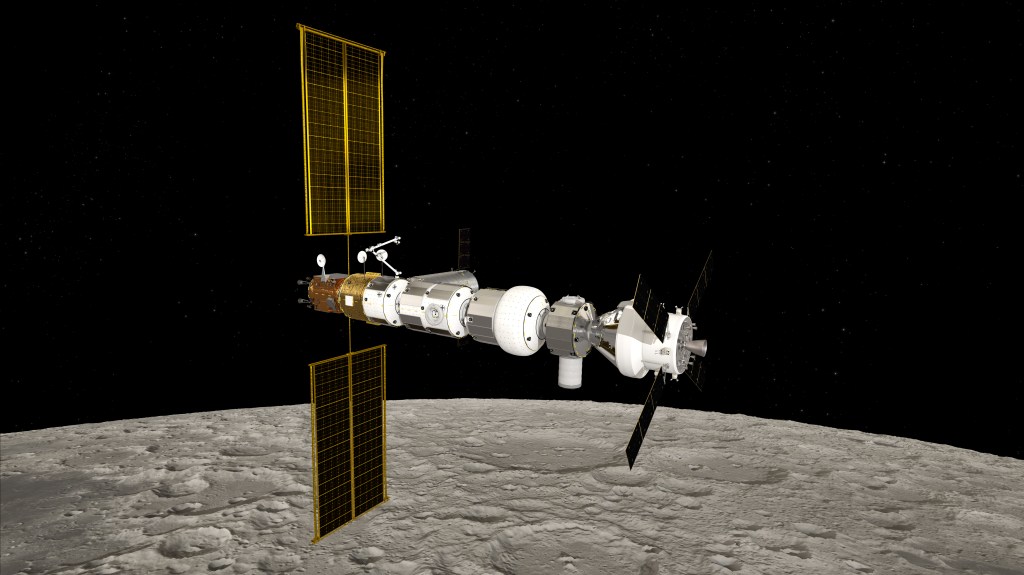
Mention the future of human space exploration and I can guarantee you that the Moon will crop up in conversation, with the two being spoken about in tandem. It also seems to be dominating space agencies’ mission plans, fuelling speculation that we are on the brink of a second space race to return to our companion satellite. The prospect has received mixed-reactions, with some cautious about the consequences of colonising another world. 

Lunar Gateway_with_Orion_over_Moon
ESA/NASA/ATG Medialab

NASA promptly turned their focus back to lunar development following the US Space Policy Directive-1 (2017), which set out that: “the United States will lead the return of humans to the Moon for long-term exploration and utilisation, followed by human missions to Mars and other destinations..” 

They were not alone in doing so; other agencies including ESA, JAXA and Roscosmos have all had lunar initiatives running alongside other exploratory missions. The Global Exploration Roadmap, produced by a forum of of 15 space agencies (known as the International Space Exploration Coordination Group (ISECG)) illustrates the emerging consensus and partnership towards furthering human presence in the Solar System – with the Moon being the next logical step. 

The usual concerns still crop up – a primary one being the expense of a renewed lunar programme. NASA alone will be spending 51% of its total proposed 2020 budget on lunar development, despite the overall pot of money being smaller by 2.2% compared to 2019. Activities such as Earth Sciences and STEM will take a hit.

It is unclear how much other agencies are committing or what missions will be sacrificed as a result. Although a scaled-up year-on-year budget should provide reassurances, there are still concerns that costs will balloon, jeopardising timelines and therefore other deep space missions. Collaboration with private organisations should mean a leaner commercial model, although we know from past problems that stellar-performing programme managers will be vital to keep everything on track. 

With so much sacrifice and risk, is it worth it? Well, although the Apollo missions broadened our understanding of the Moon, we have really only explored a tiny fraction of it – there’s more to discover.

Earlier this year, China’s Chang’e-4 landed on the far side of the Moon for the very first time in space history, in an unexplored region of the South Pole-Aitken basin. As the largest and oldest basin on the Moon, its thinner crust has left the lunar mantle exposed at the surface. We may be able to access to pristine samples dating back to the early Solar System, which could reveal the origins of the Earth-Moon system, as well as the formation of Earth. 

Given that we have well-developed robotics out in space already, some may argue that lunar science alone cannot be reason enough to build a human outpost. In an A&G article “Why we should build a Moon village”, Dr Ian Crawford, a Senior Research Associate at the Birbeck College, University of London and past SPA President, explains that many scientific fields ranging from planetary science, astronomy, astrobiology, life sciences and fundamental physics might benefit. He says, “Having humans living and working on the lunar surface for long periods is likely to result in unanticipated discoveries that might not otherwise be made.”  

The wheels are already in motion to get us there. In April 2019, NASA released ambitious timelines to land astronauts on the Moon by 2024. Partnering with organisations and international agencies, they are simultaneously developing the Orion spacecraft and Space Launch System (SLS) to be launch-ready by 2020, a Lunar Gateway (Gateway) and reusable lander by 2022 and 2023, and finally a crewed mission in 2024. The emphasis on sustainable architecture permeates everything too.

Part of the urgency lies in the intense interest from all agencies in establishing access to the Moon’s resources. On the surface, the Moon looks like a barren wasteland; look beyond and it is rich in resources such as water ice. Polar water-ice deposits could be extracted and processed to produce propellant in situ – known as In Situ Resource Utilisation (ISRU). Spacecraft could use the Gateway or Moon Village as refuelling ports and a launch pad – a much cheaper alternative than hauling it from Earth. ESA is currently researching the feasibility of conducting Moon ISRU by 2025, starting with a prospecting exercise in partnership with Russia’s Luna-27 mission in 2022 to detect and characterise polar volatiles. 

Fuel resource is just the tip of the iceberg. A permanent base needs life support and power systems, water supplies, consumables and materials. This expands it from being merely a petrol station to a scalable lunar industry, with many opportunities for commercialisation and tourism, as well as a new scientific laboratory from which we can study space.

No one wants to be left out and this need to have a stake in colonisation, some ownership of the process, may be the biggest challenge we must overcome to avoid destroying all the progress made. 

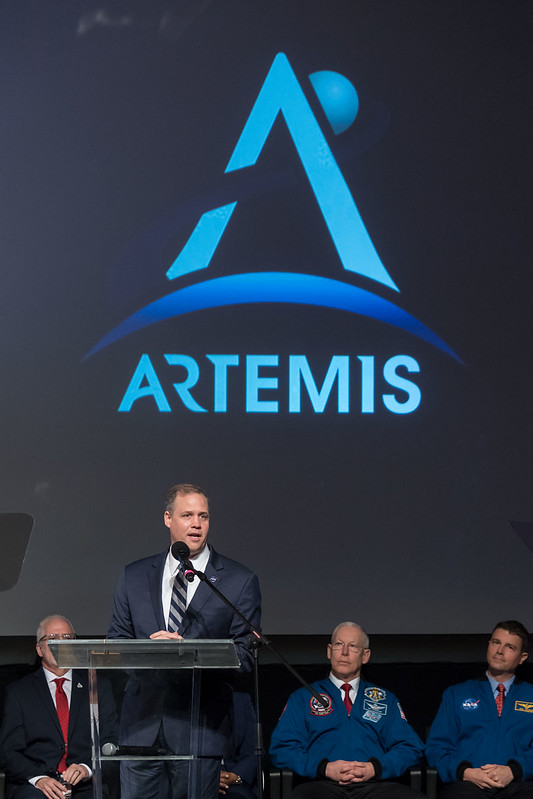
In a press release NASA Administrator, Jim Bridenstine said, “This time, when we go to the Moon, we will stay. We will use what we learn as we move forward to the Moon to take the next giant leap – sending astronauts to Mars.” Yet some critics think that the Moon is an unwelcome distraction that could upend the plans for Mars, despite plans for Mars sample missions to run in parallel to a lunar programme.

Mars is still the horizon goal and NASA remains optimistic on reaching Mars in the 2030s. In a 2014 report by the US National Research Council called Pathways to Exploration, an independent committee concluded that “a return to extended surface operations on the Moon would make substantial contributions to a strategy ultimately aimed at landing people on Mars.”  

NASA Administrator Jim Bridenstine with Artemis logo in background
Credit: NASA/flikr

Simply put, it’s not in our own interests to head straight to Mars. It is still unknown territory despite the information collected by orbiters and rovers from afar. The Moon is a safer environment to test technology, equipment and the psychological impact of leaving our mother planet and living on another celestial body. If something were to go wrong, the Moon is just a three-day journey; people can be brought back or supplies can be ferried relatively quickly. 

However, some will argue that the dissimilarities between the Moon and Mars makes it a limited safety-net for realistically testing living conditions. Surely Earth’s more comparable environment and climate offers a shade more realism? One problem with this is that it greatly underestimates the psychological aspects. 

From Mars, the Earth and Moon look like bright evening or morning stars to the naked eye. Astronauts will have to mentally acclimatise to feelings of isolation, far from everything and everyone. One of the most memorable quotes from the Apollo 11 mission is that of Michael Collins waiting in the Lunar Command Module for his colleagues to return: “I am alone now, truly alone, and absolutely isolated from any known life.” We need to begin that adaptation – and only truly will when placed into a real environment.

A new venture to the Moon could be exactly the thing to spark inspiration in the next generation – our scientists and engineers of the future – and to act as a catalyst for emerging technology that not only benefits space exploration but also the Earth.

Certainly in an age of widely accessible information failures will face far more public scrutiny. Yet, Israel’s agency, SpaceIL’s recent attempt to land a probe on the Moon demonstrates that even in the event of failure, people focused on the positives, for reaching the Moon still has a certain magic.

There may be setbacks – the sheer amount of work to be done requires deep breaths and steady nerves – but the thought of witnessing the first Gateway or the first touchdown on the Moon in over 50 years fills me with excitement and wonder. 

This feature article was published in Popular Astronomy, July 2019 issue.

Space exploration 2020 and beyond: the top missions to watch

Published January 2020.

A new year brings with it a plethora of new space missions to look forward to. In this issue, we’ve outlined some of the upcoming space exploration missions over the next few years that aim to expand our understanding of the Solar System and deliver new science and technology.

1: Mars 2020

NASA’s Mars 2020 mission continues the team’s endeavours to prepare for human exploration of the red planet in the 2030s. Mars 2020 aims to launch a rover in July 2020, landing in the Jezero Crater in February 2021. Modelled on Curiosity, this car-sized, albeit heavier, rover will carry an array of instruments to seek signs of ancient life, collect and store soil and rock samples for a future return mission and demonstrate future technologies. Among this includes a new landing technique known as Terrain-Relative Navigation, which essentially allows the rover to determine its location relative to the ground as it descends and can trigger an autopilot function to avoid hazardous areas. Descents through the Martian atmosphere have proved challenging for past missions, limited by the ability to detect relative location and having to instead pick a target landing zone before descending. As a result, landing target zones have been on the safer plains of Mars. Using the TNR, the Mars rover will be able to explore riskier zones that potentially contain primitive, unseen material. Another neat piece of kit is the MOXIE, an instrument designed to convert Mars’ carbon dioxide into oxygen – a vital instrument if humans are to set foot on Mars. Although there are several Mars missions, this one forms part of the bridge from the Moon, to Mars that NASA has set as its decadal vision.

2: ExoMars 2020

Hot on NASA’s heels follows the joint ESA-Roscosmos ExoMars rover mission, also due to launch in July
2020 and arrive at Mars in March 2021. It will also demonstrate key, future technologies for a safe entry,
descent and landing (EDL) to the Martian surface, mobility across the tricky terrain and conduct in-situ
sample analysis thanks to the Russian-built surface lab known as Kazachok. A main science focus will be
on studying the exobiology and geochemistry of preserved, subsurface materials. Oxia Planum is the
chosen landing site, beating the other potential candidate, Mawrth Vallis. Both sites are located just north
of the equator and have regions containing channels that cut through the southern highlands into the
northern lowlands. However, Oxia Planum is the safer of the two sites for landing and has the largest
exposure of rocks dating back to around 3.9 billion years old, so should help to achieve those science
goals.

3: Starship and Crew Dragon

In September last year, Elon Musk stood in front of a full-sized prototype of Space X’s latest fleet member: Starship. Standing 50 metres high and wrapped in gleaming stainless steel, this behemoth of a spacecraft is designed to transport 100 people into space and perform vertical ascents and descents much like the Falcon boosters. Musk has indicated that with testing underway, his ambition is for Starship to conduct its first orbital test flight in 2020. It would be an amazing feat of engineering if the orbital launch arrives as early as he says. Closer to achieving its goals, is the seven-man capacity spacecraft Crew Dragon, which suffered setbacks last year, causing delays to the much anticipated manned test flight.
NASA and SpaceX maintain the focus remains on Crew Dragon and that they aim to have a manned flight in 2020 with two astronauts on board. All in all, it could be an exciting year for SpaceX.

4: James Webb Space Telescope

Having garnered attention for the wrong reasons (recent delays and overspend), the James Webb Space Telescope (JWST) has been making steady progress following replanning and is on track to launch in March 2021. In August 2019, the JWST was fully assembled for the first time along with its scientific instruments, sunshield and the spacecraft into one single observatory – a significant milestone for the project. Designed to operate in very low temperatures of around -230 C, the JWST will be able to observe in the near and mid-infrared wavelengths. Combined with its size (its primary mirror is approximately seven times larger than its predecessor, Hubble), it also carries four scientific instruments that will enable it to capture faint objects, allowing us to look back further into the universe than ever before.

5: Gaganyaan

In 2019, all eyes were on India’s Space Agency (ISRO) as it attempted to land its spacecraft, Chandrayaan-2 on the Moon. Although they didn’t quite succeed, it captured the world’s attention and respect. ISRO announced that it will attempt another moon landing in 2020 (Chandrayaan-3) but it also talked about another lesser known mission, Gaganyaan. Gaganyaan is India’s mission to send astronauts into space by the end of 2021. The crew module is already in development as are the engines that will be used on a human-rated version of the GSLV MK-III launch vehicle. The ISRO is working to ambitious timelines and plans to conduct its first unmanned tests in December 2020. If India succeed in this mission, they will become only the fourth nation to send humans into space. 

6: Psyche

A pretty cool mission name, isn’t it? NASA’s tag line for this is a “mission to a metal world”. Indeed Psyche, named after the ancient Greek goddess of the soul, is one of the ten largest asteroids in the asteroid belt located between Mars and Jupiter. Psyche is unique in that it is made of metal, rather than rock or ice, thought to be a product of violent impacts that may have stripped away its mantle. Left behind is an exposed nickel-iron core of a protoplanet, similar to that though to exist at the centre of the terrestrial planets (but are unreachable for observation). By studying this core, NASA hopes to learn more about the early formation of the rocky planets and how they came to accrete metal cores. We could discover that an entirely different process was responsible for Psyche’s creation and that would be equally exciting. The Psyche spacecraft is due to launch in 2022 and reach the asteroid’s orbit in 2026, where it will conduct observations for 21 months.

7:  JUICE 

JUICE (JUpiter ICy moons Explorer) is the first large mission under ESA’s ten-year Cosmic Vision programme. With the go ahead given in April 2019 to begin production, launch is planned for 2022, arriving at Jupiter in 2029. Over three years, JUICE will study the gas giant and make detailed observations of Jupiter’s three largest moons, Ganymede, Callisto and Europa, with Ganymede being the predominant focus. Among the themes for the Cosmic Vision programme is the emergence of life, and JUICE will focus on the habitable environments around gas giants, using Jupiter as the archetype and blueprint for other solar systems. For a long time, we have speculated over what lies beneath the icy exterior of these satellites and how they formed, so this mission is one to watch. 

8: Europa Clipper 

Since 1979 when Voyager returned images of Europa, the smallest of Jupiter’s four Galilean moons,  scientists have strong evidence to believe that beneath its water-ice crust, it harbours a salty, liquid ocean – more liquid than all of the Earth’s oceans combined – and may potentially have the right conditions conducive to life. NASA’s Europa Clipper is planned for launch this year, although at the time of writing, there is no firm date. The spacecraft will journey to Jupiter and from there, conduct 45 close passes of Europa, over the course of which it will scan the entire moon. Each pass will vary in trajectory and in altitude, ranging from 2700 kilometres to 25 kilometres above the moon’s surface. Europa Clipper will scan the moon for subsurface oceans, and collect data on its depth, chemistry and composition, relaying data back to the mission team for analysis after each flyby. 

9: China’s Space Station

Although China’s Chang’e-4 mission to the Moon garnered a lot of attention, the Chinese National Space Administration (CNSA) has also been diligently working on another project: its  own space station. Known as the Tiangong programme, the CNSA has set the goal of completing a modular space station by 2022, and is on its way to doing so having already launched two space laboratories, Tiangong 1 and 2 in 2011 and 2016 (both have been subsequently deorbited). No date has been confirmed as yet but it is thought that the core module of the CSS, known as Tianhe will be ready for launch in 2020. The core module will provide life support systems, living quarters and docking stations, while 2 other modules will follow to provide experimentation labs. The CSS will be able to board three astronauts at a time, and the CNSA has indicated that it is very much intended as an international platform, to replace the ISS when it retires.

10: Artemis 1

We couldn’t do a top ten without mentioning, what is set to be the biggest programme of space exploration of the decade. Artemis, NASA’s mission to go back to the Moon and establish a lunar gateway deserves a call out, despite a Moon landing still being at least four years away. NASA has stated that it is targeting 2020 for Artemis 1 (formerly Exploration Mission-1) to send an uncrewed test flight of the SLS and Orion spacecraft together into lunar orbit. Its timeline includes 2022 for Artemis 2 to send a crewed test flight into lunar orbit and to begin constructing the first element of the Lunar Gateway in space, followed by Artemis 3 in 2024, where they hope to once again, set man down on the Moon. Ambitious, big and compelling.

This article was featured in Popular Astronomy, January 2020 issue.

Farewell Oppy

← Back to my work Popular Astronomy · May 2019

Published May 2019. “Science is an emotional affair, it is a team sport and that is what we are celebrating today”.

These were the fitting words of Thomas Zurbuchen, Associate Administrator for the Science Mission Directorate at a NASA press conference on 13th February 2019. In a poignant address, NASA announced that the Mars Exploration Rover, Opportunity, would explore no more following the worst martian dust storm in decades.

In the wake of the news, many took to social media to thank the mission team for their decades of work and to bid farewell to the rover. Twitter trended with the hashtag #ThanksOppy and countless messages and images were shared in dedication to the intrepid, little rover. Opportunity’s demise has evoked a mixture of feelings, both palpable sadness and yet, fierce pride and optimism. 

Even though we know it’s just a machine, we’ve projected our humanity onto and into it through its anthropomorphised design (whether intentionally or incidental), and carry the hopes and ambitions of its mission team family. It’s been a cornerstone in creating a close, bonded community – a positive outcome if we are thinking about human exploration of other worlds. 

The tenacity and dedication of the mission team – and an over-achieving rover has meant that the Mars Exploration Rovers program has been a resounding success, completing the most extensive exploration of another world than any other mission to date and producing definitive evidence that liquid water was once present on Mars.

There is much to celebrate. Opportunity landed on Mars on 24th January 2004 in the Eagle Crater, ready for its 90-sol mission (92.5 Earth days) and no one thought that it would still be here almost 15 years later. Powered by solar arrays, the mission team had expected the panels to be covered by dust before long. They never expected the martian winds to give Opportunity a complimentary cleaning service. 

Together with its twin, Spirit, they uncovered a realm of discoveries and relayed beautiful imagery of Mars worthy of the halls of martian science fiction.

To think that it almost never happened. One of the best anecdotes I came across, was of the team’s worry that Opportunity carried the same software glitch that had caused Spirit to malfunction shortly after landing on Mars. With Opportunity already in space, the team sent a software update while the rover was in transit and prayed it would be enough. It was.

One of the mission goals for both of the geologist rovers concerned collecting evidence of a martian environment where water had been stable and that was once hospitable to life. 

Within weeks of landing in the Meridiani Planum region, Opportunity showed us that this region had once been wet, confirming theories that it may have hosted a body of water. Within a month, it sent back its infamous images of small spherical balls of mineral hematite, which typically form in water containing iron, and will forever be nicknamed ‘blueberries’.  Within a decade it had outlived Spirit, (which fell silent in 2011), became the longest operational rover on Mars, and found further tell-tale signs of water when it discovered veins of mineral gypsum (a hydrated calcium sulfate) in the rocks surrounding the rim of the Endeavour Crater. 

You’d think that these were enough accomplishments for one rover. But no, Opportunity kept on. In its last 5 years, it reached the marathon-distance milestone – the mission team even celebrated by naming a region “Marathon Valley” and visited over 100 impact craters. In 2013 it made, quite possibly, its greatest scientific discovery: clay minerals found near the Endurance Crater, that would have formed in neutral-PH water – basically the kind of water that comes out of our taps. 

Both rovers had other mission goals too, focussed on studying the climate and geology. Not only did this contribute further supporting evidence of water but also supported a fourth mission goal: preparing for human exploration.

As it traversed the surface of Mars, Opportunity surveyed the martian environment, its atmosphere, its craters, its hazards, allowing us to paint a picture of what martian life might be like. 

The science delivered really is astounding, and undoubtedly Opportunity takes its place among robotic greats like Cassini. Although luck played its part, much of Opportunity’s endurance of the harsh environment was down to the ingenious mission engineers.

The team made sure the rover was sturdy (a six-wheel design to keep its weight evenly spread and prevent it from toppling over on steep inclines) and durable (aluminium and titanium mobility systems) to overcome the countless challenges presented by the harsh terrain. But they didn’t stop once the rover was off the ground. As one NASA post explains, often the engineers would drive the rover backward in order to extend the front wheels’ life. At another point, the team devised a way to shimmy Opportunity out of a soft-sand dune, where it had been stuck for several weeks. 

The climate was equally unforgiving at times. Swinging temperatures meant that Opportunity’s solar panels were constantly tilted towards the sun so that the rover could continue to work in martian winter.  

In July 2007, Opportunity also survived a month-long dust storm powering down until the skies cleared. It was touch and go, as the temperature of the electronics dropped, concerns arose that the rover would deplete its remaining power to stay warm. Seasonal winds helped to blow the dust off the solar panels and after two-nail biting months, Opportunity was back at work. 

In the end, what luck the planet had bestowed on Opportunity, it took away. A severe dust storm in June 2018 blotted the martian skies, preventing Opportunity from recharging its batteries. Hunkered down in a region known as the Perseverance Valley, its final message was a status report indicating dark skies and low power. The rover’s fate hung precariously in the balance.

Back on Earth, astronomers shared Opportunity’s misery. The dust storm scuppered clear observations of Mars’ surface features during the red planet’s most promising opposition and perigee since 2003, both of which occurred within days of each other in July 2018. By September the martian skies had cleared enough for the mission team to send wake-up calls to Opportunity. This time, however, Opportunity did not pick up.

Prepare your hankies for NASA’s final farewell message. The mission team sent over a thousand recovery messages, initially including cheerful songs such as Wham’s ‘Wake me up before you go-go’. After months of silence, on 12th February 2019, NASA sent its final wake up song, Billie Holiday’s ‘I’ll Be Seeing You’, an emotional surrender of their beloved rover to the red planet.

Opportunity will forever remain at Perseverance Valley. It is a well-deserved resting spot for the rover that redefined our understanding of Mars. John Callas, the project manager for Opportunity said, “Fifteen years on the surface of Mars is testament not only to a magnificent machine of exploration but the dedicated and talented team behind it that has allowed us to expand our discovery space of the Red Planet.”

The current world climate we live in is full of challenges that at times can lead us to question our humanity; but it is moments like this that demonstrate our greatest potential, our limitless reach if we dream and if we can find it in ourselves to imprint our heart and soul into a robot.

Farewell Oppy, and thank you. 

This feature article was published in Popular Astronomy, May 2019 issue.